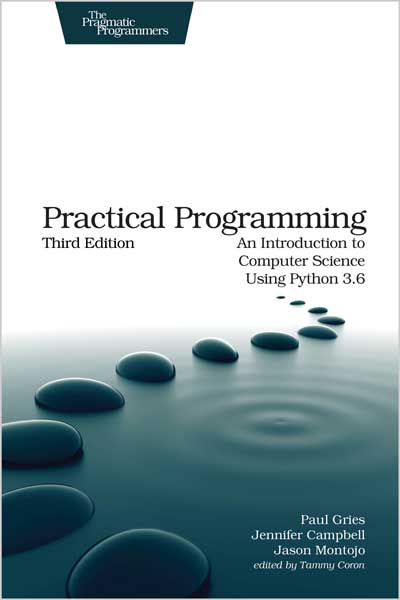
Classroom-tested by tens of thousands of students, this new edition of the bestselling intro to programming book is for anyone who wants to understand computer science. Learn about design, algorithms, testing, and debugging. Discover the fundamentals of programming with Python 3.6–a language that’s used in millions of devices. Write programs to solve real-world problems, and come away with everything you need to produce quality code. This edition has been updated to use the new language features in Python 3.6.
This book uses the Python programming language to teach introductory computer science topics and a handful of useful applications. You’ll certainly learn a fair amount of Python as you work through this book, but along the way you’ll also learn about issues that every programmer needs to know: ways to approach a problem and break it down into parts, how and why to document your code, how to test your code to help ensure your program does what you want it to, and more.
We chose Python for several reasons:
- It is free and well documented. In fact, Python is one of the largest and best-organized open source projects going.
- It runs everywhere. The reference implementation, written in C, is used on everything from cell phones to supercomputers, and it’s supported by professional-quality installers for Windows, macOS, and Linux.
- It has a clean syntax. Yes, every language makes this claim, but during the several years that we have been using it at the University of Toronto, we have found that students make noticeably fewer ‘punctuation’ mistakes with Python than with C-like languages.
- It is relevant. Thousands of companies use it every day: it is one of the languages used at Google, Industrial Light & Magic uses it extensively, and large portions of the game EVE Online are written in Python. It is also widely used by academic research groups.
- It is well supported by tools. Legacy editors like vi and Emacs all have Python editing modes, and several professional-quality IDEs are available.
Our Approach
We have organized the book into two parts. The first covers fundamental programming ideas: how to store and manipulate information (numbers, text, lists, sets, dictionaries, and files), how to control the flow of execution (conditionals and loops), how to organize code (functions and modules), how to ensure your code works (testing and debugging), and how to plan your program (algorithms).
The second part of the book consists of more or less independent chapters on more advanced topics that assume all the basic material has been covered. The first of these chapters shows how to create and manage your own types of information. It introduces object-oriented concepts such as encapsulation, inheritance, and polymorphism. The other chapters cover testing, databases, and graphical user interface construction.
About the Author
Paul Gries has been teaching in the Department of Computer Science at the University of Toronto for more than 15 years. During his time at UofT, Paul has won numerous teaching awards, has co-authored two textbooks, has been a leader in departmental curriculum design and renewal, and with Jennifer Campbell, got to teach Python to tens of thousands of students in a MOOC.
Jennifer Campbell is a teaching stream professor in Computer Science at the University of Toronto. In 2014, she received the Faculty of Arts and Science Outstanding Teaching Award. Jen engages in computer science education research, studying student experiences, factors for success, and the effectiveness of various course formats, including flipped and online courses.
Jason Montojo is a veteran software developer with 19 years of professional experience. He specializes in applied software archaeology and has mentored dozens of students as part of the Google Summer of Code and Software Carpentry programs.

نقد و بررسیها
هنوز بررسیای ثبت نشده است.