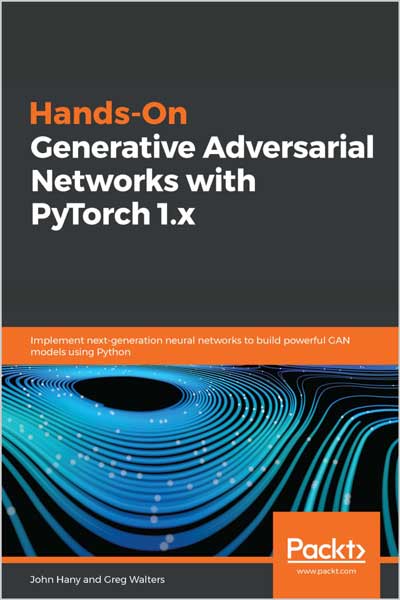
Apply deep learning techniques and neural network methodologies to build, train, and optimize generative network models
Key Features
- • Implement GAN architectures to generate images, text, audio, 3D models, and more
- • Understand how GANs work and become an active contributor in the open source community
- • Learn how to generate photo-realistic images based on text descriptions
Book Description
With continuously evolving research and development, Generative Adversarial Networks (GANs) are the next big thing in the field of deep learning. This book highlights the key improvements in GANs over generative models and guides in making the best out of GANs with the help of hands-on examples.
This book starts by taking you through the core concepts necessary to understand how each component of a GAN model works. You’ll build your first GAN model to understand how generator and discriminator networks function. As you advance, you’ll delve into a range of examples and datasets to build a variety of GAN networks using PyTorch functionalities and services, and become well-versed with architectures, training strategies, and evaluation methods for image generation, translation, and restoration. You’ll even learn how to apply GAN models to solve problems in areas such as computer vision, multimedia, 3D models, and natural language processing (NLP). The book covers how to overcome the challenges faced while building generative models from scratch. Finally, you’ll also discover how to train your GAN models to generate adversarial examples to attack other CNN and GAN models.
By the end of this book, you will have learned how to build, train, and optimize next-generation GAN models and use them to solve a variety of real-world problems.
What you will learn
- • Implement PyTorch’s latest features to ensure efficient model designing
- • Get to grips with the working mechanisms of GAN models
- • Perform style transfer between unpaired image collections with CycleGAN
- • Build and train 3D-GANs to generate a point cloud of 3D objects
- • Create a range of GAN models to perform various image synthesis operations
- • Use SEGAN to suppress noise and improve the quality of speech audio
Who this book is for
This GAN book is for machine learning practitioners and deep learning researchers looking to get hands-on guidance in implementing GAN models using PyTorch. You’ll become familiar with state-of-the-art GAN architectures with the help of real-world examples. Working knowledge of Python programming language is necessary to grasp the concepts covered in this book.
Table of Contents
1. Generative Adversarial Networks Fundamentals
2. Getting Started with PyTorch 1.3
3. Best Practices for Model Design and Training
4. Building Your First GAN with PyTorch
S. Generating Images Based on Label Information
6. Image-to-Image Translation and Its Applications
7. Image Restoration with GANs
8. Training Your GANs to Break Different Models
9. Image Generation from Description Text
10. Sequence Synthesis with GANs
11. Reconstructing 30 models with GANs
About the Author
John Hany received his master’s degree and bachelor’s degree in calculational mathematics at the University of Electronic Science and Technology of China. He majors in pattern recognition and has years of experience in machine learning and computer vision. He has taken part in several practical projects, including intelligent transport systems and facial recognition systems. His current research interests lie in reducing the computation costs of deep neural networks while improving their performance on image classification and detection tasks. He is enthusiastic about open source projects and has contributed to many of them.
Greg Walters has been involved with computers and computer programming since 1972. He is well-versed in Visual Basic, Visual Basic .NET, Python, and SQL and is an accomplished user of MySQL, SQLite, Microsoft SQL Server, Oracle, C++, Delphi, Modula-2, Pascal, C, 80×86 Assembler, COBOL, and Fortran. He is a programming trainer and has trained numerous people on many pieces of computer software, including MySQL, Open Database Connectivity, Quattro Pro, Corel Draw!, Paradox, Microsoft Word, Excel, DOS, Windows 3.11, Windows for Workgroups, Windows 95, Windows NT, Windows 2000, Windows XP, and Linux. He is semi-retired and has written over 100 articles for Full Circle Magazine. He is also a musician and loves to cook. He is open to working as a freelancer on various projects.





نقد و بررسیها
هنوز بررسیای ثبت نشده است.