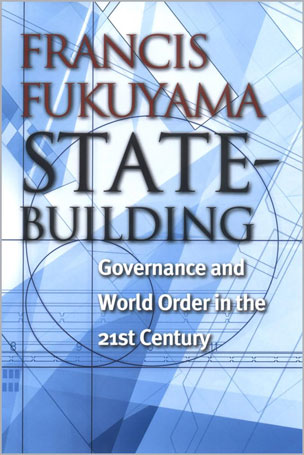
Francis Fukuyama famously predicted “the end of history” with the ascendancy of liberal democracy and global capitalism. The topic of his latest book is, therefore, surprising: the building of new nation-states. The end of history was never an automatic procedure, Fukuyama argues, and the well-governed polity was always its necessary precondition. “Weak or failed states are the source of many of the world’s most serious problems,” he believes. He traces what we know―and more often don’t know―about how to transfer functioning public institutions to developing countries in ways that will leave something of permanent benefit to the citizens of the countries concerned. These are important lessons, especially as the United States wrestles with its responsibilities in Afghanistan, Iraq, and beyond.
Fukuyama begins State-Building with an account of the broad importance of “stateness.” He rejects the notion that there can be a science of public administration, and discusses the causes of contemporary state weakness. He ends the book with a discussion of the consequences of weak states for international order, and the grounds on which the international community may legitimately intervene to prop them up.
Table of Contents
1. The Missing Dimensions of Stateness
2. Weak States and the Black Hole of Public Administration
3. Weak States and International Legitimacy
4. Smaller but Stronger
Review
Fukuyama asserts that the lack of ‘organizational tradition’ in ‘failed or weak’ nations such as Afghanistan and Haiti represents the greatest threat to an orderly world. He argues that the United States, and the West in general, after rightly intervening in such states either militarily or economically (most often through the IMF or World Bank), have failed to transfer institutional and public- and private-sector know-how to needy countries…. Since he sees the ‘international community’ represented by the United Nations as a myth because it lacks a military, the mantle of leadership must be worn by the U.S., at great risk to itself…. Fukuyama’s ideas will no doubt be much discussed.
― Publishers Weekly
Fukuyama is a wonderful synthesizer of grand subjects, an adventurer who doesn’t mind summing up the history of development theory in one chapter and the history of organizational theory in the next. He pulls this off with minimal resort to jargon, and he pulls the reader along with him.
― Washington Post Book World
Fukuyama persuasively argues that the great problems of our day―’from poverty to AIDS to drugs to terrorism’―result not from excesses of the state but from its persistent weakness or utter failure in many countries….’ State collapse or weakness had already created major humanitarian and human rights disasters during the 1990s in Somalia, Haiti, Cambodia, Bosnia, Kosovo, and East Timor.’ Americans once could believe that such disasters would affect us only to the degree that we chose to help out by sending cash or peacekeepers. But 9/11, of course, showed that even a rich and powerful country remains vulnerable to catastrophes brewed in distant, troubled lands.
― Baltimore Sun
This is a very useful, intelligent, and short book by Francis Fukuyama, a leading political thinker. It examines a central issue in the age of terrorism: the perils (and sometimes necessities) of ‘state-building’ in weakened failed states. One hopes it will become a must-read for State Department policymakers.
― National Review
From the Publisher
“This is a brilliant, sober, insightful look at a difficult issue which happens to be the central issue of our time. For the Bush administration and for its critics, and for leaders and policy-makers across the globe, Francis Fukuyama’s analysis should be required reading.”Robert Kagan, Senior Associate, Carnegie Endowment for International Peace
About the Author
Francis Fukuyama is a senior fellow and the Mosbacher director of the Center on Democracy, Development, and the Rule of Law at Stanford University. He is the author of Political Order and Political Decay, State-Building, The End of History and the Last Man, The Origins of Political Order, America at the Crossroads, and Falling Behind.



نقد و بررسیها
هنوز بررسیای ثبت نشده است.