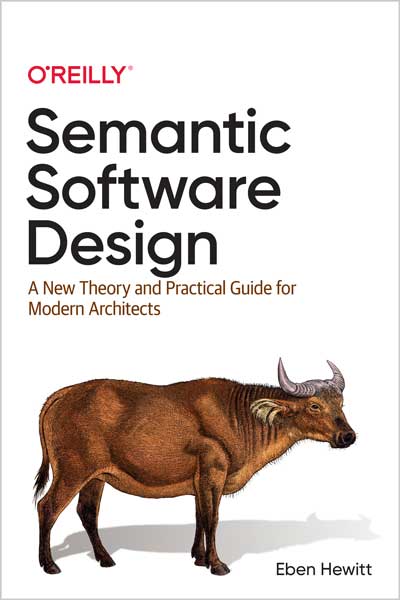
With this practical book, architects, CTOs, and CIOs will learn a set of patterns for the practice of architecture, including analysis, documentation, and communication. Author Eben Hewitt shows you how to create holistic and thoughtful technology plans, communicate them clearly, lead people toward the vision, and become a great architect or Chief Architect.
This book covers each key aspect of architecture comprehensively, including how to incorporate business architecture, information architecture, data architecture, application (software) architecture together to have the best chance for the system’s success.
- Get a practical set of proven architecture practices focused on shipping great products using architecture
- Learn how architecture works effectively with development teams, management, and product management teams through the value chain
- Find updated special coverage on machine learning architecture
- Get usable templates to start incorporating into your teams immediately
- Incorporate business architecture, information architecture, data architecture, and application (software) architecture together
About This Book
This book introduces a new method of software design. It proposes a new way of thinking about how we construct our software. It is primarily focused on large projects, with particular benefit for greenfield software projects or large-scale legacy modernization projects.
My assumption here is that you’re making business application software and services to be sold as products for customers or you’re working at an in-house IT department.
This book is not about missile guidance systems or telephony or firmware. It’s not interested in debates about object-oriented versus functional programming, though it could apply for either realm.
It’s certainly not interested in some popular framework or another. And for the sake of clarity, my use of “semantic” here traces back to my philosophical training, and as such, it concerns the matter of signs. “Semantic” here refers more to semiology. It is not related or confined to some notion of Tim Berners-Lee’s concept of the Semantic Web, honorable as that work is.
The primary audience is CTOs, CIOs, vice presidents of engineering, architects of all stripes (whether enterprise, application, solution, or otherwise), software development managers, and senior developers who want to become architects. Anyone in technology, including testers, analysts, and executives, can benefit from this book.
But there is precious little code in the book. It is written to be understood, and hopefully embraced, by managers, leaders, intellectually curious executives, and anyone working on software projects. That is not quite to say that it’s easy.
The first part of the book presents a philosophical framing of the method. We highlight what problem we’re solving and why. This part is conceptual and provides the theoretical ground.
The second part of the book is ruthlessly pragmatic. It offers an array of document templates and repeatable practices that you can use out of the box to employ the elements of this method in your own daily work.
The third part provides an overview of some ways you manage and govern your software portfolio to help contain the general entropy.
The book ends with a manifesto that summarizes concisely the set of principles and practices that comprise this method.
Taken altogether, the book represents a combined theoretical frame and a gesture toward its practice. It is not closed, however, and is intended to be taken up as a starting point, elaborated, and improved upon.
About the Author
Eben Hewitt is the chief architect and CTO at Sabre Hospitality where he is responsible for the technology strategy, designing large-scale, mission-critical systems, and leading teams to build them. He works at the intersection of innovation, architecture and design, leadership, and global enterprise business development. He has served as CTO at one of the world’s largest hotel companies and as CIO of O’Reilly Media. Eben has originated architecture departments at three companies. He is also the author of Technology Strategy Patterns (2018), and Cassandra: The Definitive Guide (two editions, translated into Chinese), and several other books on architecture, services, Java, and web development. He has won awards for innovation and been an invited presenter to Amazon AWS, Oracle headquarters, and conferences around the world. He is a full member of the Dramatists Guild, with his first full-length play produced in New York City.





نقد و بررسیها
هنوز بررسیای ثبت نشده است.