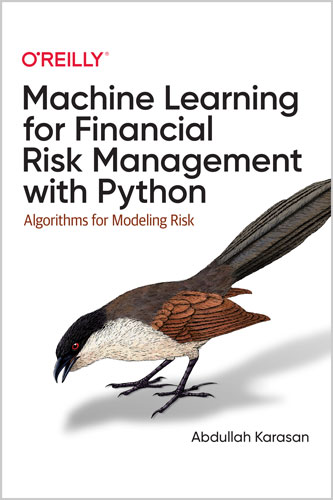
Financial risk management is quickly evolving with the help of artificial intelligence. With this practical book, developers, programmers, engineers, financial analysts, risk analysts, and quantitative and algorithmic analysts will examine Python-based machine learning and deep learning models for assessing financial risk. Building hands-on AI-based financial modeling skills, you’ll learn how to replace traditional financial risk models with ML models.
Author Abdullah Karasan helps you explore the theory behind financial risk modeling before diving into practical ways of employing ML models in modeling financial risk using Python. With this book, you will:
-
- • Review classical time series applications and compare them with deep learning models
- • Explore volatility modeling to measure degrees of risk, using support vector regression, neural networks, and deep learning
- • Improve market risk models (VaR and ES) using ML techniques and including liquidity dimension
- • Develop a credit risk analysis using clustering and Bayesian approaches
- • Capture different aspects of liquidity risk with a Gaussian mixture model and Copula model
- • Use machine learning models for fraud detection
- • Predict stock price crash and identify its determinants using machine learning models
Financial modeling has a long history with many successfully accomplished tasks, but at the same time it has been fiercely criticized due mainly to lack of flexibility and non-inclusiveness of the models. The 2007–2008 financial crisis fueled this debate as well as paved the way for innovations and different approaches in the field of financial modeling.
Of course, the financial crisis was not the only thing precipitating the growth of AI applications in finance. Two other drivers, data availability and increased computing power, have spurred the adoption of AI in finance and have intensified research in this area starting in the 1990s.
The Financial Stability Board (2017) stresses the validity of this fact:
Many applications, or use “cases,” of AI and machine learning already exist. The adoption of these use cases has been driven by both supply factors, such as technological advances and the availability of financial sector data and infrastructure, and by demand factors, such as profitability needs, competition with other firms, and the demands of financial regulation.
As a subbranch of financial modeling, financial risk management has been evolving with the adoption of AI in parallel with its ever-growing role in the financial decision-making process. In his celebrated book, Bostrom (2014) denotes that there are two important revolutions in the history of mankind: the Agricultural Revolution and the Industrial Revolution. These two revolutions have had such a profound impact that any third revolution of similar magnitude would double the size of the world economy in two weeks. Even more strikingly, if the third revolution were accomplished by AI, the impact would be way more profound.
So expectations are sky-high for AI applications shaping financial risk management at an unprecedented scale by making use of big data and understanding the complex structure of risk processes.
With this study, I aim to fill the void about machine learning-based applications in finance so that predictive and measurement performance of financial models can be improved. Parametric models suffer from issues of low variance and high bias; machine learning models, with their flexibility, can address this problem. Moreover, a common problem in finance is that changing distribution of the data always poses a threat to the reliability of the model result, but machine learning models can adapt themselves to changing patterns in a way that models fit better. So there is a huge need and demand for applicable machine learning models in finance, and what mainly distinguish this book is the inclusion of brand-new machine learning-based modeling approaches in financial risk management.
In a nutshell, this book aims to shift the current landscape of financial risk management, which is heavily based on the parametric models. The main motivation for this shift is recent developments in highly accurate financial models based on machine learning models. Thus, this book is intended for those who have some initial knowledge of about finance and machine learning in the sense that I just provide brief explanations on these topics.
Consequently, the targeted audience of the book includes, but is not limited to, financial risk analysts, financial engineers, risk associates, risk modelers, model validators, quant risk analysts, portfolio analysis, and those who are interested in finance and data science.
In light of the background of the targeted audience, having an introductory level of finance and data science knowledge will enable you to benefit most from the book. It does not, however, mean that people from different backgrounds cannot follow the book topics. Rather, readers from different backgrounds can grasp the concepts as long as they spend enough time and refer to some other finance and data science books along with this one.
Editorial Reviews
Nowadays, Python undoubtedly is the No. 1 programming language in the financial industry. At the same time, Machine Learning has become a key technology for the industry. The book by Abdullah Karasan does a great job in showing the capabilities of Machine Learning with Python in the context of financial risk management — a function vital to any financial institution.
Dr. Yves J. Hilpisch
This book is a comprehensive and practical presentation of a wide variety of methods, drawn from both the statistical and machine learning traditions, for the analysis of financial risk. It includes practical code snippets and charts to illustrate the methods used on real data. If you need a go-to guide to the application of these methods to data, this is a great place to start.”
Graham L Giller, author of Adventures in Financial Data Science.
About the Author
Abdullah Karasan was born in Berlin, Germany. After studying economics and business administration, he obtained his master’s degree in applied economics from the University of Michigan, Ann Arbor, and his PhD in financial mathematics from the Middle East Technical University, Ankara. He is a former Treasury employee of Turkey and currently works as a principal data scientist at Magnimind and as a lecturer at the University of Maryland, Baltimore. He has also published several papers in the field of financial data science.



نقد و بررسیها
هنوز بررسیای ثبت نشده است.