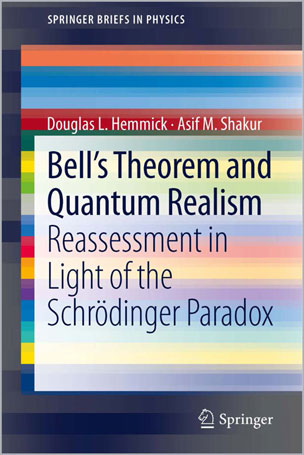
Quantum theory presents a strange picture of the world, offering no real account of physical properties apart from observation. Neils Bohr felt that this reflected a core truth of nature: “There is no quantum world. There is only an abstract mathematical description.” Among the most significant developments since Bohr’s day has been the theorem of John S. Bell. It is important to consider whether Bell’s analysis supports such a denial of microrealism. In this book, we evaluate the situation in terms of an early work of Erwin Schrödinger. Doing so, we see how Bell’s theorem is conceptually related to the Conway and Kochen Free Will theorem and also to all the major anti-realism efforts. It is easy to show that none of these analyses imply the impossibility of objective realism. We find that Schrödinger’s work leads to the derivation of a new series of theoretical proofs and potential experiments, each involving “entanglement,” the link between particles in some quantum systems.
Table of Contents
1 Introduction
2 Contextuality
3 The Einstein–Podolsky–Rosen Paradox, Bell’s Theorem and Nonlocality
4 Schrodinger’s Paradox and Nonlocality





نقد و بررسیها
هنوز بررسیای ثبت نشده است.